
Friday, January 13, 2017
Field work out in the playa out side of Lordsburge

Tuesday, August 23, 2016
Radium Springs heavy rain event on August 21, 2016
Intense rainfall upwards of 4 inches fell on Radium Springs, New Mexico from a late Sunday evening storm on August 21. Two CoCoRaHS observers in Radium Springs recorded impressive amounts of rain from this storm. The observer at Leasburg Dam State Park measured 4.04 inches by the morning of August 22. Another observer northwest of the park measured 3.83 inches. Observers to the south measured respectable amounts but not nearly as much as that in Radium Springs.
 The Santa Teresa radar indeed verified a rainfall hotspot in this area. Below is a screenshot of the 24-hour radar based precipitation by the morning of August 22. The marker in the map below is an approximate location of the park where the 4.04 inch was measured.
 The evening sounding (6 pm) at Santa Teresa showed the deep moisture over the area and a precipitable water amount of 1.18 inches. The morning sounding had a precipitable water of 1.33 inches. Vertical structure of the convective clouds over the area were impressive this late in the evening. Radar estimated cloud tops were in the ballpark of 34,000 feet based on the plot below.
 An animation of the radar reflectivity shows the storm's trajectory from the west.

Cold cloud tops from this GOES infrared map also indicated the strength of this storm.
 The radar also picked up hail signature at the height of the storm. The dual polarization radar product (HHC) shows hail in this plot as red. When I visited the park I verified hail with the campground host. The size of the hail was about pea size or 1/4 inch.
 A snap shot of the radar base reflectivity was high at the peak of this storm and extended across the area.
 A flood advisory was issued by the El Paso National Weather Service office in the area about the time of this event.

I visited the State Park on Monday afternoon and wanted to view the impacts of this amount of rain on the area. By the time I started my trek it was about 12 hours after the storm. I first drove along Valley Drive (highway 185) from Las Cruces toward Radium Springs. Stopping along the way to view the Rio Grande as it crossed Picacho Avenue (highway 70) I noticed the high level compared to what I am used to. This is the Rio Grande looking north at the Picacho bridge.
 The next stop was a viewpoint of the river just north of Dona Ana as the road was close to the water. The river level was about the same as the Picacho crossing.
 A few miles north of Radium Springs from the road provided a nice vista overlooking a very full river. However I didn't see any flooding but it was right up to the bank.
 I did notice a location where there had been water flow over highway 185 north of Radium Springs. No water remained when I was there but the debris left over from last night was still present and it was obvious that water had flowed over the road at this location.
 At that same location I did see a little erosion of the banks upstream from this storm.
 There were some ponding on the side of the road driving into Radium Springs on the west side of the village near the post office. In this part of town there was not a lot of ponding remaing 12 hours after the rain but it was evident it rained.
 Runoff and debris on the roads within the Radium Springs community was much more severe. At a few locations up to a foot of soil was deposited on the road and by the time I arrived a county road grader was already on the job clearing the roads. The photo below was on DeBeers Road.
 and looking in the other direction
 Flowing water on the access road to the Masson Farms had eroded part of the area under the railroad.
 Some erosion undercut a retaining wall and fire hydrant at the corner of Hurt and Desert Edge Roads.
 The most ponding that I saw was along the railroad on Tres Amigos Road and it appeared impassable with a normal vehicle due to the depth of water.
 A few parcels had standing water remaining after the storm.
 In the park I didn't see any major damage or flooding although Leasburg Dam was very full and one log remained on the top of the dam. I was told that there was another log on the dam but that was pushed downstream by the time I was there.
 From the hard work of our CoCoRaHS observers we were able to know about this rainfall and document the impacts from an exceptional event. Below is our CoCoRaHS observer at the park, Park Manager Evaristo Giron who measured the 4.04 inch storm.

Intense rainfall upwards of 4 inches fell on Radium Springs, New Mexico from a late Sunday evening storm on August 21. Two CoCoRaHS observers in Radium Springs recorded impressive amounts of rain from this storm. The observer at Leasburg Dam State Park measured 4.04 inches by the morning of August 22. Another observer northwest of the park measured 3.83 inches. Observers to the south measured respectable amounts but not nearly as much as that in Radium Springs.


Cold cloud tops from this GOES infrared map also indicated the strength of this storm.


I visited the State Park on Monday afternoon and wanted to view the impacts of this amount of rain on the area. By the time I started my trek it was about 12 hours after the storm. I first drove along Valley Drive (highway 185) from Las Cruces toward Radium Springs. Stopping along the way to view the Rio Grande as it crossed Picacho Avenue (highway 70) I noticed the high level compared to what I am used to. This is the Rio Grande looking north at the Picacho bridge.


Monday, August 1, 2016
Are we back from the dead? No, our office is very much alive and kicking. It was just our blog that has had a near death experience. It's time we bring it back to life. So what have we been up to this past year? Read on to find out!
In May of 2014, a deadly crash related to a dust storm killed 7 people on I-10 by the Lordsburg Playa. Because of that, we have been making regular trips out to the Lordsburg, NM Playa area to study the dust storm issue.
http://krqe.com/2014/05/22/7-killed-in-crash-west-of-lordsburg/
As a result of our trips, we have compiled a video of several dramatic dust storms our cameras have captured over the past year. Below you can see some of that footage.
https://www.youtube.com/watch?v=oFdI9TE8Fyc
We have also been working to maintain our USRCRN stations that we inherited from our Federal partners, making trips to the sites to empty the Geonor rain gauges and fix any problems that may arise.
Finally, we have been installing Davis Vantage Pro 2 weather station in our community as part of an outreach program, or in partnership with the NM Viticulture Program.
Speaking of Twitter, because of our UTEP summer intern, Maryflor, we now have a New Mexico CoCoRaHS Twitter feed and a snazy new logo to go along with it. Check it out when you get the chance. Our tireless NM State Climatologist, Dr. Dave DuBois, also keeps up with Twitter and provides a Twitter feed that shouldn't be missed. The field technician and software developer for our office, Stanley Engle, also maintains his own feed, tweeting his take on weather and climate related information. Finally, we partner closely with the NM Viticulture program as we participate in weather station activities together. Please follow their account for all things wine in New Mexico.
That's all for now. Stay tuned for more information about our activities in the coming weeks.
Dust
In May of 2014, a deadly crash related to a dust storm killed 7 people on I-10 by the Lordsburg Playa. Because of that, we have been making regular trips out to the Lordsburg, NM Playa area to study the dust storm issue.
http://krqe.com/2014/05/22/7-killed-in-crash-west-of-lordsburg/
As a result of our trips, we have compiled a video of several dramatic dust storms our cameras have captured over the past year. Below you can see some of that footage.
https://www.youtube.com/watch?v=oFdI9TE8Fyc
 |
| NMSU students Kacie DeSomer and Trevor Nash downloading images from the playa cameras. May 2016. |
Weather Stations
Over the past year, we've worked tirelessly to bring some of our older Agricultural (Ag.) weather stations back up to working order, upgrading most of the components and sensors. During this upgrade process, we have also changed the communications method from old school dial-up over the phone, to a more advanced radio/network telemetry system. There is still a lot of work to do on our Ag. network, but progress continues.We have also been working to maintain our USRCRN stations that we inherited from our Federal partners, making trips to the sites to empty the Geonor rain gauges and fix any problems that may arise.
 |
| NMSU staff member Stanley Engle dowloading data from a USRCRN weather station on top of Magdalena Ridge, near Socorro, NM. |
Finally, we have been installing Davis Vantage Pro 2 weather station in our community as part of an outreach program, or in partnership with the NM Viticulture Program.
 |
| NMSU staff member Stanley Engle installs a Davis Vantage Pro 2 weather station while UTEP intern Maryflor Garcia watches. |
Website
If you are a regular visitor to our website, you'll have noticed a major change in layout. We now use the updated NMSU theme, which also makes our website more mobile friendly. The "behind the scenes" code has also gone through several revisions so that we can lay the groundwork for more interesting data products in the near future. If you haven't yet visited us, please do so at http://weather.nmsu.edu.Social Media
Obviously this blog is part of our social media outreach. Unfortunately we let it slide into oblivion as we concentrated more on our various Twitter accounts. No more. Every effort will be made to provide more information not only on our Twitter accounts, but also right here in the bloggerverse (Is that a thing?).Speaking of Twitter, because of our UTEP summer intern, Maryflor, we now have a New Mexico CoCoRaHS Twitter feed and a snazy new logo to go along with it. Check it out when you get the chance. Our tireless NM State Climatologist, Dr. Dave DuBois, also keeps up with Twitter and provides a Twitter feed that shouldn't be missed. The field technician and software developer for our office, Stanley Engle, also maintains his own feed, tweeting his take on weather and climate related information. Finally, we partner closely with the NM Viticulture program as we participate in weather station activities together. Please follow their account for all things wine in New Mexico.
That's all for now. Stay tuned for more information about our activities in the coming weeks.
Enjoy the Show!
 |
| Our 2016 summer crew! From left to right: Viticulture Weather Specialist Elizabeth Smith, PhD candidate in computer science Antonio Arredondo, UTEP summer intern Maryflor Garcia, field tech and software developer Stanley Engle, NMSU grad student Zahra Ghodsizadeh, NMSU undergrad Trevor Nash. |
 |
| Part of our 2015 summer crew! From left to right: NMSU grad student Yizhi Zhao, NMSU summer intern Kacie DeSomer, UTEP summer intern Ana Quevedo, Viticulture Weather Specialist Elizabeth Smith. |
 |
| NMSU PhD candidate Antonio Arredondo helping out with an outreach event last summer. |
 | ||
| NMSU staff member Stanley Engle recruiting students attending AMS to come to NMSU for grad school. |
 |
| Our former Program Specialist and NMSU alumni Reyes Duran doing her part to measure precipitation in New Mexico. |
 |
| NMSU student Kacie DeSomer, NMSU professor Dr. DeAntonio, and NMSU staff member Stanley Engle downloading weather data from the Lordsburg Playa. |
 |
| Our fearless leader, NMSU professor and NM State Climatologist Dr. Dave DuBois saying "See you next time!" |
Friday, July 3, 2015
July 4th, 2014 Precipitation and temperatures in New Mexico.
The 4th of
July is just around the corner and with that, all the cookouts and parties. Below you will find last year's temperature and precipitation data, as well as normals and extremes for several locations in New Mexico. As
I’m sure you have noticed, we don't get lots precipitation in New Mexico on the 4th, however we do get some. Last year we got very little
rain or none at all on the 4th of July, and in many cities, 2014 has
been the year with the lowest precipitation in record for the 4th of
July. Having no precipitation is usually
something we are not very happy about, but considering all the festivities that
come with that specific date it is good news. Hopefully we will not be getting
any rain this year so we can celebrate the 4th of July with our
typical barbeques. In temperature July 4th, 2014 did not differ much
from normal. It is usually a hot sunny day but we should be used to it in New
Mexico.
The data is collected from NWS Coop weather stations and since these stations are usually manually read in the mornings, I used July 5th data to get the maximum temperature and total precipitation data. To get the minimum temperature data, I used July 4th. Data is retrieved from http://scacis.rcc-acis.org/.
Have a Happy 4th of July.

Thursday, July 2, 2015
Las Cruces Firework safety and
instructions
June is coming to an end, here comes July, people are getting
ready for some of the best fun of the summer season. The month starts off with
a bang July 4th, we celebrate the great country we live in with fireworks,
barbeque, family and friends. Living in New Mexico means that we have to be
especially careful not to start any fires while celebrating Independence Day,
many areas of the state are very dry. There are certain rules and regulations
on lighting fireworks in New Mexico and they differ depending on where you live
in the state. Before lighting any fireworks check with the county you live in
to see what is and is not allowed. Firework stands have to abide by the local laws
so buy local and shoot the fireworks off in the same county you bought them in.
I’ve gone ahead and looked into what is being allowed in the Las Cruces city limits
as well as Dona Ana county. The fireworks that can be bought and sold are
ground and hand held sparkling and smoking devices only. Examples of some of
these fireworks are cone fountains, crackling devices, cylindrical fountains,
flitter sparklers, illuminator torches, smoke devices, and wheels (Ramirez S.).
Things that are not allowed are aerial fireworks (the ones that shoot into the
sky); aerial spinners, roman candles, helicopters, chargers, and firecrackers
(Ramirez S.). This year firework stands will be inspected more to ensure that
local laws are enforced (Ramirez S.) and firework sales end July 6th.
When lighting your own fireworks, try to only light them on paved areas or
barren land, make sure to have water available in case a fire does occur, and
by no means should children (under 16) be left unsupervised with fireworks
around (Ramirez S.). Make sure to light fireworks one at a time, and never
light off fireworks if you are inebriated (toasted, drunk, borracho, loaded or
otherwise impaired)(Ramirez S.)
If you don’t want to buy and light
off your own fireworks for the 4th there are some great events you can attend
locally to celebrate. Concerts and fireworks will be held in Las Cruces at the
public schools sports complex also known as the field of dreams (Las Cruces
events). There is parking available at Mayfield high school, Picacho middle
school, and at the stadium (Las Cruces events). Do not bring your RV’s,
trailers, personal fireworks, grills, or pets as none are allowed. This is a
free event and all are encouraged to attend the activities going on throughout
the day. Youth activities start at noon and when day turns to night the evening
is completed by a firework display at 10 (Las Cruces events). Make sure to be
safe and have fun on this 4th of July!
Ramirez, S.
(n.d.). Fireworks sales for Fourth of July holiday begin Saturday. Retrieved
June 23, 2015.
Las cruces events calendar. (n.d.). Retrieved June 23,
2015.
Monday, May 4, 2015
May 4, 2015
I spent two great days at the Mescalero Apache School at their second annual student STEM conference. I was invited by Mike Montoya to give a series of climate change talks to a bunch of high schoolers from all over the region. The students were mainly from tribal schools and some came from as far as Flagstaff and Cuba, NM. The fair started off with a speech from retired Commander John Herrington who flew on the Shuttle Endeavour (STS-113) and did a space walk to install parts of the International Space Station. The students and staff at the school did a great job in running the conference and made it enjoyable.
 In total I gave 7 talks and answered a
bunch of questions. More than half of them said that they had a course in environmental sciences at their school. I tested them on their knowledge of basic things
like the greenhouse effect and while most of them knew of it, the
majority couldn't give any details on how it worked. Hopefully I
improved their knowledge by the end of the conference.
In total I gave 7 talks and answered a
bunch of questions. More than half of them said that they had a course in environmental sciences at their school. I tested them on their knowledge of basic things
like the greenhouse effect and while most of them knew of it, the
majority couldn't give any details on how it worked. Hopefully I
improved their knowledge by the end of the conference.

I spent two great days at the Mescalero Apache School at their second annual student STEM conference. I was invited by Mike Montoya to give a series of climate change talks to a bunch of high schoolers from all over the region. The students were mainly from tribal schools and some came from as far as Flagstaff and Cuba, NM. The fair started off with a speech from retired Commander John Herrington who flew on the Shuttle Endeavour (STS-113) and did a space walk to install parts of the International Space Station. The students and staff at the school did a great job in running the conference and made it enjoyable.


Tuesday, March 17, 2015
Our office is going to be co-hosting the 13th Annual Climate Prediction Applications Science Workshop (CPASW) at NMSU on March 24-26. This will bring together climate researchers, information producers, and users to share developments in research and applications of climate predictions for societal decision-making. The workshop theme is "Climate and Drought Information for Food Resilience, Agriculture, and Water Resources.“
Student registration is $25 and regular is $175. Visit our website for more information: http://cpasw.nmsu.edu

Student registration is $25 and regular is $175. Visit our website for more information: http://cpasw.nmsu.edu

Sunday, February 1, 2015
Last Week's Winter Storm
Much of New Mexico experienced winter weather last week as a winter storm made it's way across the state. Snow began to develop in Southern Colorado and Northern New Mexico on the evening of the 20th, continuing on the 21st and finally affecting the Southern part of New Mexico on the 22nd.
The NM Department of Transportation reported several closures over multiple highways across the state. Schools were also affected. According to NM news sources, over 90 schools were affected by last week's storm. Here in Las Cruces, NMSU was closed at 10AM and the Las Cruces Public Schools let out early, allowing staff to leave after 1PM.
Weather station data from last week's storm shows that many locations across New Mexico recorded heavy snowfall. Other locations saw none at all. The following map shows CoCoRaHS snowfall amounts across the state.

Although the State Climatologist, Dr. Dave DuBois, was out of town during the storm, the staff at the climate center was able to capture images of the storm as it passed through Las Cruces.
Several weeks ago, the students and staff of the NM Climate Center attended the American Meteorological Society's Annual Meeting in Phoenix, AZ. This year the theme of the conference was "Fulfilling the Vision of Weather, Water, and Climate Information for Every Need, Time, and Place." We arrived early on the weekend prior to the start of the full meeting to take the Python short course. As a Python programmer already, I attended the advanced Python short course, while my colleagues, Dr. Dave DuBios, Yizhi Zhao, and Rebecca Britt-Armenta attended the beginner course.
Every year the conference reaches out to the community by holding a WeatherFest where weather and atmospheric sciences are promoted. This year looked very successful and many kids and their parents attended the event. Here are a few photos from WeatherFest.


On the first Monday of the meeting, I attended the Fifth Symposium on Advances in Modeling and Analysis Using Python. The major takeaway from this symposium is that Python is here to stay in the atmospheric sciences. Later on Monday, we attended the exhibit presentations to see the latest and greatest technology available for the atmospheric sciences.
Of course, one of the most popular exhibits is the NOAA Science on a Sphere. This would be a good place to get a group picture.
Unfortunately, I had to leave after Monday, but Dr. DuBois, Yizhi and Rebecca stayed for a few more days. Rebecca found that the most interesting experience at AMS was attending several talks. A few noteworthy presentations included those in the "Global Warming Hiatus" on the first day of the conference and several sessions on the National Climate Assessment. Dr. DuBois gave the talk A perspective on drought information services at a state climate office. According to Rebecca, about 30 meeting attendees listened to his presentation. Below is a view of that presentation.

The NM Department of Transportation reported several closures over multiple highways across the state. Schools were also affected. According to NM news sources, over 90 schools were affected by last week's storm. Here in Las Cruces, NMSU was closed at 10AM and the Las Cruces Public Schools let out early, allowing staff to leave after 1PM.
Weather station data from last week's storm shows that many locations across New Mexico recorded heavy snowfall. Other locations saw none at all. The following map shows CoCoRaHS snowfall amounts across the state.
Although the State Climatologist, Dr. Dave DuBois, was out of town during the storm, the staff at the climate center was able to capture images of the storm as it passed through Las Cruces.
 |
| The NMSU weather station taken by Rebecca Britt-Armenta |
 |
| Another view of the NMSU weather station by Rebecca Britt-Armenta |
 |
| A neighborhood in Las Cruces by Stanley Engle |
 |
| Another neighborhood in Las Cruces by Antonio Arredondo |
On Another Note
Several weeks ago, the students and staff of the NM Climate Center attended the American Meteorological Society's Annual Meeting in Phoenix, AZ. This year the theme of the conference was "Fulfilling the Vision of Weather, Water, and Climate Information for Every Need, Time, and Place." We arrived early on the weekend prior to the start of the full meeting to take the Python short course. As a Python programmer already, I attended the advanced Python short course, while my colleagues, Dr. Dave DuBios, Yizhi Zhao, and Rebecca Britt-Armenta attended the beginner course.
 |
| Rebecca and Yizhi learning Python by Dr. Dave DuBois |
On the first Monday of the meeting, I attended the Fifth Symposium on Advances in Modeling and Analysis Using Python. The major takeaway from this symposium is that Python is here to stay in the atmospheric sciences. Later on Monday, we attended the exhibit presentations to see the latest and greatest technology available for the atmospheric sciences.
 | ||
| A Davis Vantage Pro2 weather station by Stanley Engle |
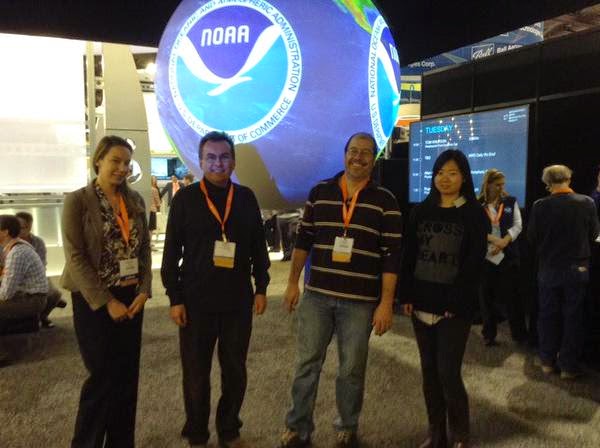 |
| Rebecca, Dave, Stan and Yizhi at AMS Annual Meeting 2015 |
Monday, November 10, 2014
Modular Environmental Monitoring Sensors (MEMS)
Early last month, the NM Climate Center team built and a Modular Environmental
Monitoring Sensor (MEMS) package, which was tested at the 2014 Albuquerque Balloon Fiesta. The purpose of
building and testing the MEMS is to demonstrate our ability to gather data using inexpensive
equipment. The hardware was chosen for
its low cost and power.

The Raspberry Pi, Arduino Uno, and all power hardware is stored in a Rubbermaid container that is placed inside an inexpensive backpack. The Dylos is attached to the outside of the backpack to be exposed to the ambient air.


 Photo 6: Testing the sensor hardware at the Balloon Fiesta. Photo by D. DuBois

MEMS system parts and functions:
Raspberry Pi – Read data from the Arduino Uno and Dylos.
Arduino Uno Micro Controller – Programmed to read pressure and GPS data from a pressure sensor and a GPS module. It is connected to the Rasberry Pi via USB.
Dylos Air Quality Monitor - Counts large and small particle sizes and stores the average of both sizes over a minute. Connected to the Raspberry Pi via Serial-to-USB adapter.
12V Rechargeable Battery - Provides the power to all the components of the system.


Photo 1: MEMS system and parts. By: Cristina González
An Arduino Uno was used to collect GPS
and pressure sensor data. A Raspberry Pi
was used to log data from the Arduino serial console; the GPS messages and our
own custom data message format for the pressure sensor. In addition to logging
data from the Arduino, the Raspberry Pi logged data from the Dylos air quality monitor.
A start-up script was created for the Raspberry Pi to trigger data logging on
start-up.
The Raspberry Pi, running the Raspbian OS, booted into a standard terminal mode. During the boot process, an init script would start the data collection process from the Arduino and the Dylos serial ports. This data was then stored in an incrementing file name, to prevent overwriting files, over each on-off power cycle. In addition, a one minute file-write timer was built into the logging software to ensure that data was written on a continuous basis, since the sensor package was turned off by having its power removed.
The Raspberry Pi, running the Raspbian OS, booted into a standard terminal mode. During the boot process, an init script would start the data collection process from the Arduino and the Dylos serial ports. This data was then stored in an incrementing file name, to prevent overwriting files, over each on-off power cycle. In addition, a one minute file-write timer was built into the logging software to ensure that data was written on a continuous basis, since the sensor package was turned off by having its power removed.
The Raspberry Pi, Arduino Uno, and all power hardware is stored in a Rubbermaid container that is placed inside an inexpensive backpack. The Dylos is attached to the outside of the backpack to be exposed to the ambient air.
After completing the build process, the MEMS was
tested on October 11, 2014 at the Ballon Fiesta (photo 6). It collected
data successfully and it will be available soon in the NM Climate Center
website.
Photo 2: Building a bracket to hold the Dylos air quality monitor . The bracket is used to securely hold the Dylos to the backpack. The Dylos had to be exposed to the air outside of the backpack. Photo by: Stanley Engle

Photo 3: Attaching it to the backpack for trial. Photo by: Stanley Engle
Photo 4: Testing it at NMSU. It was left outside for an
hour. Photo by: Stanley Engle
Photo 5: Data logger inside the backpack. Photo by: Stanley Engle
Photo 7: Testing the sensor hardware at the Balloon
Fiesta. Photo by D. DuBois
Subscribe to:
Posts (Atom)